


The Importance of Financial Planning & Working With a Trusted Advisor
The current investment landscape has made it easier than ever for individuals to purchase numerous types of investments, but this comes with its own set of challenges. One can ask themselves, what do I buy? Is the valuation reasonable? What is the payout ratio? When should I sell? Will I have enough capital to educate my children and retire? Should I buy index funds? What happens if I sell with a gain or a loss?
These questions can lead down numerous rabbit holes for individuals, and no single answer is right for everyone. This is why working with an accredited and experienced financial planner is so important as it allows you to work with a licensed professional who is qualified to answer all your financial planning questions, provide advice and guidance, and guide you to your desired outcomes on your wealth creation journey. That is my mandate as your trusted advisor that you can rely on for planning and guidance to ensure you and your family are financially prepared.
As such, I want to talk about the value of a professional Portfolio Manager and Certified Financial Planner, some changes coming to the industry in the new year and how those updates relate to you. For decades, investment advisors have been measured against a single benchmark or index, and the question became: “can you beat the market?”. Over the past 10+ years, this question has been slowly reframed and in 2025, Vanguard’s Advisor’s Alpha Framework argues that the real value beyond selecting investments is not whether an advisor can beat the market through picking singular stocks, but rather the real value is in behavior, planning, and portfolio construction.
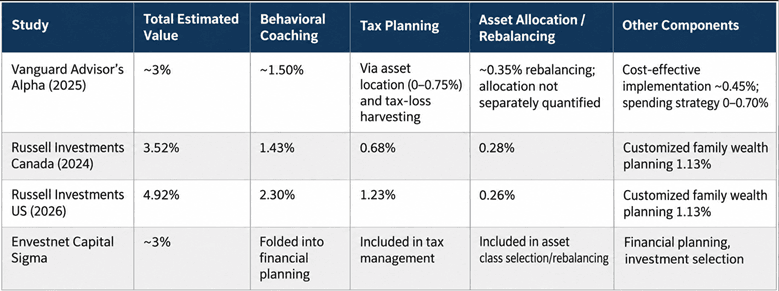
What this means is that instead of focusing on singular stocks, bonds, ETFs, mutual funds and private assets attempting to outpace the market (which is part of the process), it’s also about the behavioral coaching, cost-effective implementation, and disciplined portfolio rebalancing. Vanguard’s findings in their study on investment managers and portfolio managers determined that the long-term value add from working with a trusted advisor is “about 3%” in net annualized returns through the aforementioned measurable practices. Beyond Vanguard, several independent firms, most notably Morningstar, have done their own tests on this and came to broadly similar numbers through testing with different methodologies.
Now, 3% may not sound like a lot, but when spacing this out from a young age to retirement compounds significantly, and in retirement could be the difference between maintaining your portfolio value and income with inflation and could further be the difference between passing on your portfolio to the next generation or outliving your assets. In exchange for the minimal price paid in fees for working with us, this leads to numerous value-added portfolio management techniques. At a recent conference I attended, Purpose Investments Ltd went through the breakdown of value-added advice, and I felt it important to share this with you all.
The first, as mentioned, is behavioral coaching – preventing panic sells, checking biases, and making sure your emotions align with your long-term goals. By acting as the emotional stabilizer, my focus is on your end goal, not the day-to-day noise in the market. Ask yourself, if the market fell 30% as it did during COVID or 50% as it did in 2008/early 2009, could I hold my portfolio without selling? Would you know what to buy in the market downturn? The fees paid on your accounts act as the insurance policy to protect you in such circumstances, by insuring against the things you can’t afford to lose, like your life, home, cottage, or car. The same applies to your portfolio. Insuring against the risk of unknowingly derailing your financial objectives by acting with emotion. The return benefit from Vanguard’s study on this turned out to be the largest contributor to long term value and added ~1.50%. My father and I witnessed many, many situations where clients panicked and would have sold near or at the worst moments in time had we not successfully intervened.
The second contributor was cost effective implementation. Every investment carries a cost, and some are more cost effective than others, but in exchange for price, may not give the results you seek. The opposite can be true as well as the underlying cost may look like it’s “premium” but in reality, eat into the net returns of the investment. This winter, you will be receiving a new statement as part of an industry update called “Total Cost Reporting”. This report will show you in terms of dollar values how much an underlying investment costs and how much it made you in exchange for that price.
Once again, we come back to price is what you pay, value is what you get. The selection of low cost, but strategy effective exchange traded funds and mutual funds in conjunction with individual stocks was found to add ~0.45% to average investment returns. Being a licensed Portfolio Manager, I am not bound to any singular investment provider or issuer, and as such, have access to the entire global marketplace and can choose the best-in-class investments, for the most competitive price. With recent industry changes, these costs are becoming increasingly transparent and competitive in the marketplace competing for your investment dollars. I welcome this!
Finally, on the major contributors, it was found that disciplined rebalancing, even when some of the winners keep going up, added on average a long term ~ 0.35% annualized. This is largely due to risk management and preventing overconcentration through adherence to the implemented strategy. Now, you may be saying to yourself, 1.50%, 0.45% and 0.35% don’t add up the stated “about 3.00%” and you’d be correct. In fact, they add up to about 2.30%. It was found that underneath these three measurable practices were two variables; asset location (placing the right assets in the right account types for tax purposes) and spending strategy in retirement (sequencing withdrawals efficiently), can each add anywhere from 0.00%-0.75% depending on a client’s situation and implementation of said strategies. Remember as well, that over 90% of investors are not accredited (higher net worth or income levels). They cannot access high quality private or alternative investments on their own that can add additional stability, income/growth. By working with a licensed Portfolio Manager, you automatically have access – through me.
All together, we can see that the price paid in fees is only good as the value received from them, and Vanguard (as well as numerous other published studies) have shown the enhanced “value added” of working with a qualified, professional financial advisor/portfolio manager. The resultant enhanced returns are well in excess of the fees paid for advice and management.
I have also included the summary of these studies below to illustrate this further as at Prittie Private Wealth, in addition to Portfolio Management, we offer financial planning, both in the form of advice and written plans, tax planning, insurance planning, and estate planning which some studies found to add additional value.
Bringing this back to the original theme of this newsletter, we have seen a significant expansion of individual investment platforms in recent years, but by working together, you have chosen to work with an advisory practice that supports advice seeking individuals on a comprehensive planning platform for family wealth creation and management. Whether this be long term portfolio management, written financial plans, establishing an insurance strategy for tax minimization, or simply being the emotional insurance policy to protect your assets in an economic downturn, not all returns are measured on the index.
Some returns are measured in how much money you keep in your pocket each year as compared to how much CRA receives from you, some returns are measured in how much income you get in retirement through tax planning, and sometimes it’s how much you get to leave to the next generation. As such, the question should not be “can we beat the index” but rather can I accomplish all my financial goals in a prudent manner that minimizes risk, maximizes risk adjusted returns, and takes the stress and emotion out of having to handle the investment selection and allocation process, thus giving you more time for yourself.
I always welcome questions as they relate to our wealth creation process, strategy, and fees as it all relates to your financial well-being. I hope you find this information valuable in illustrating the value of working with a trusted advisor.
Written By: Adam Prittie